How to Choose Solar Panels for Your Homestead
You’ve decided you want solar on your homestead. Good decision. Now comes the hard part: walking into a world of watts, efficiency ratings, inverter types, and battery chemistry — and figuring out what any of it actually means for your daily life off the grid. The solar industry is full of marketing language designed to dazzle, not inform.
This guide cuts through it. Knowing how to choose solar panels for a homestead means focusing on a handful of real specs that determine whether your system will power your well pump in January or leave you running a generator. Here’s exactly what to look for — and what to ignore.
Panel Type: Monocrystalline Is the Clear Choice for Homesteads
There are two main types of solar panels sold for residential and off-grid use: monocrystalline and polycrystalline. For homesteads, monocrystalline wins — and it’s not particularly close.
Monocrystalline panels are made from a single silicon crystal structure. They’re more efficient (typically 19–23% efficiency), perform better in low-light conditions, and have a longer rated lifespan — most come with 25 to 30-year power output warranties. They’re also more space-efficient, meaning you can generate more power from a smaller area. That matters if you’re ground-mounting on limited sunny land or roof-mounting on a cabin.
Polycrystalline panels are cheaper but less efficient (13–16%) and degrade faster. The price gap has narrowed significantly, so the small savings rarely justify the tradeoff in longevity or output.
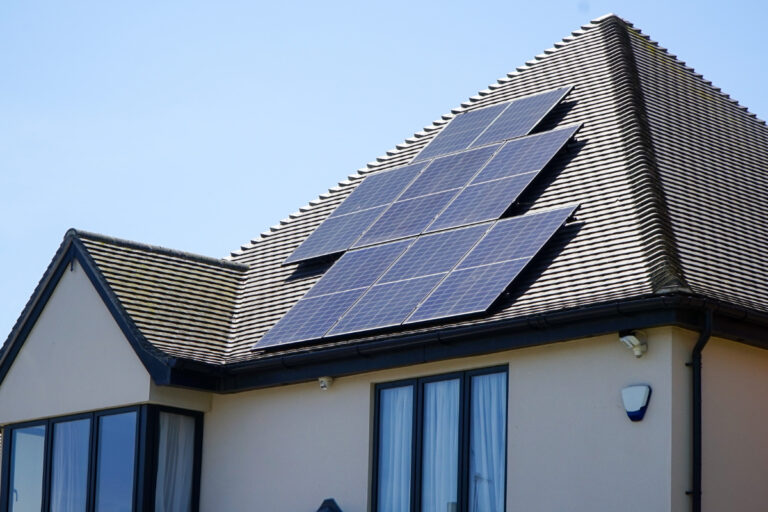
For a homestead, buy monocrystalline. Look for 400-watt panels from reputable manufacturers — that’s the current sweet spot for price per watt and output. Panels in that range typically measure about 6.5 × 3.5 feet and weigh 40 to 50 pounds each.
Wattage and System Size: Start With Your Loads
The most important number isn’t the panel’s watt rating — it’s your daily energy consumption. Everything else flows from that.
Before you size a solar system, do a simple load audit. List every device you’ll run and how many hours per day you’ll run it:
- Chest freezer (200W): 8 hours effective = 1,600 Wh/day
- Refrigerator (150W): 8 hours effective = 1,200 Wh/day
- LED lighting (50W): 5 hours = 250 Wh/day
- Well pump (800W): 1 hour = 800 Wh/day
- Phone/device charging (50W): 3 hours = 150 Wh/day
- Daily total: ~4,000 Wh (4 kWh)
A typical lean homestead runs 4 to 8 kWh per day. A small homestead with efficient appliances can get by on the low end; one with power tools, a washing machine, and electric water heating will land higher.
As a rule of thumb: divide your daily kWh need by your average peak sun hours (typically 4–6 hours for most of the US), then multiply by 1.25 to account for system losses. That gives you your required array size in kilowatts. For 4 kWh daily in a 5-sun-hour location: (4 ÷ 5) × 1.25 = 1 kW minimum. Most homesteaders size 2× their minimum to handle cloudy stretches and future growth.
Inverters: The Component Most Beginners Get Wrong
Your inverter converts DC power from panels and batteries into AC power for your appliances. Choosing the wrong type is one of the most common — and costly — mistakes in homestead solar builds.
String inverters are the most affordable ($500–$1,500) and work well for ground-mount arrays with consistent sun exposure and no shading. They treat all panels as one unit, so shading on one panel reduces output from the whole string.
Microinverters attach to each panel individually ($150–$300 per panel), allowing each panel to operate independently. They’re ideal when you’ve partial shading or panels on multiple roof faces. They cost more upfront but maximize production in complex installations.
Hybrid inverter-chargers (like the Victron MultiPlus or Sol-Ark 12K) are the best option for most off-grid homesteads. They combine the solar inverter, battery charger, and transfer switch in one unit, can accept backup generator power, and manage battery state intelligently. Expect to spend $1,500 to $4,000 for a quality hybrid unit sized for a small homestead.
For any off-grid homestead, a hybrid inverter-charger is almost always the right choice. It’s more expensive upfront but simplifies the system and gives you the most flexibility.
Battery Storage: The Heart of an Off-Grid Homestead System
Panels only produce power when the sun shines. Batteries store that power for nighttime, cloudy days, and high-demand periods. For a homestead, battery selection may matter more than panel selection.
Lithium iron phosphate (LiFePO4) batteries are the current standard for off-grid homestead systems. They offer 3,000 to 6,000+ charge cycles (roughly 10–20 years of daily use), 80–100% usable capacity, and tolerance for high discharge rates. Leading brands include Battle Born, SOK, Ampere Time, and EG4. Expect to pay $400 to $600 per kWh of usable capacity.
Flooded lead-acid batteries are much cheaper ($100–$150 per kWh) but deliver only 30–50% usable capacity, require regular watering and venting, and last just 3–5 years under daily cycling. They’re a budget starting point, not a long-term solution.
For a homestead that consumes 4 kWh per day and wants 3 days of autonomy, you’ll need 12 kWh of usable storage — roughly 15 kWh of LiFePO4 capacity (at 80% depth of discharge) or 24+ kWh of lead-acid. That’s approximately $6,000–$9,000 in lithium battery cost, which sounds steep until you realize you won’t replace them for 15 years.
Charge Controllers and System Wiring: Don’t Cut Corners Here
The charge controller sits between your panels and battery bank, regulating voltage and preventing overcharging. There are two types:
PWM (pulse width modulation) controllers are inexpensive ($30–$100) but wasteful — they’re only efficient when panel voltage closely matches battery voltage. They’re acceptable for very small, simple systems (under 200W).
MPPT (maximum power point tracking) controllers are 10–30% more efficient than PWM, and for any system over 400W, the efficiency gain pays for the higher cost ($150–$600) within months. Use MPPT for any serious homestead setup.
On wiring: use appropriately sized copper wire throughout (undersized wire wastes power and is a fire risk), weatherproof outdoor-rated conduit for exposed runs, and properly rated fuses or breakers at every connection point. If you’re not comfortable with electrical work, hire a licensed solar installer for the wiring even if you handle the panel installation yourself.
For a complete overview of system sizing, the U.S. Department of Energy’s Homeowner’s Guide to Solar is a solid starting reference.
To understand the full cost and system requirements, see our guide to off-grid solar system costs for homesteads.
Related Reading
Frequently Asked Questions
How do I choose solar panels for a homestead?
Start with a load audit to determine your daily energy use in kilowatt-hours. From there, size your panel array and battery bank accordingly. Choose monocrystalline panels rated 350–400W, a hybrid MPPT inverter-charger for off-grid use, and LiFePO4 batteries for the longest lifespan. Don’t buy equipment based on the lowest price — focus on proven components with strong warranties.
How many solar panels does a small homestead need?
A lean small homestead using 4 to 6 kWh per day typically needs 4 to 8 panels rated at 400 watts each (a 1.6 to 3.2 kW array), plus 10 to 15 kWh of battery storage. This covers lights, refrigeration, a well pump, and device charging with reserve capacity for cloudy days.
What’s the best inverter for an off-grid homestead?
A hybrid inverter-charger is the best choice for most off-grid homesteads. Models like the Victron MultiPlus-II, Sol-Ark 12K, or EG4 18K handle solar input, battery charging, generator backup, and load management in a single unit. They cost more than a simple string inverter but pay for themselves in reliability and flexibility.
Are cheap solar panels worth it for a homestead?
Generally, no. Unknown-brand budget panels often have inflated watt ratings, poor degradation rates, and no meaningful warranty support. For a homestead where panels will be operating for 25+ years, invest in panels from manufacturers with verified testing and real warranty support — brands like REC, Panasonic, Q CELLS, or Canadian Solar.
Can I build an off-grid solar system myself?
Many homesteaders successfully DIY their solar systems, especially for smaller setups. The panel mounting, basic wiring, and component connections are manageable with good instructions. However, any work that ties into your home’s electrical panel or involves conduit wiring should be done by — or at minimum reviewed by — a licensed electrician to ensure safety and code compliance.
Make the Right Choice for Your Homestead
Choosing solar panels for your homestead isn’t about finding the cheapest watt — it’s about building a system that works reliably for 25 years with minimal maintenance. Focus on monocrystalline panels, a quality hybrid inverter, LiFePO4 batteries, and MPPT charge control, and you’ll have a system that earns back its cost many times over.
Want help planning your homestead energy setup from the ground up? Visit thehomesteadmovement.com/start-here/ for resources designed specifically for aspiring and practicing homesteaders.
Size Your Solar System Without Getting Gouged
The worksheet installers don't want you to have. Figure out what you actually need before you get quoted. Free PDF.