Children’s First Aid Kit Checklist for Emergency Preparedness
Children’s First Aid Kit Checklist for Emergency Preparedness
Every family preparedness kit should include first aid supplies — but generic adult kits leave significant gaps when your patient is a child. Children’s bodies respond differently to injuries and medications. Dosages are calculated by weight. Wound dressings sized for adults cover a child’s entire forearm. Some over-the-counter medications safe for adults are dangerous for young children. Building a children’s first aid kit for emergency preparedness means thinking through the specific scenarios your kids are likely to face and making sure you’ve exactly the right supplies, in the right sizes, with the right dosage information, before an emergency makes it hard to think clearly. In this guide, you’ll get a complete children’s first aid kit checklist, plus practical advice on medications, emergency scenarios, and how to build a kit your whole family can use confidently.
Why a Generic First Aid Kit Isn’t Enough for Families
Commercial first aid kits — the ones sold at drugstores and big-box retailers — are built for an average adult user. They typically include adult-dose medications (often aspirin, which is contraindicated in children), bandages in limited sizes, and no pediatric-specific items. In an emergency where a child is injured, you’ll be frustrated discovering that your “family first aid kit” doesn’t have the specific items you need.
The good news: supplementing a basic kit with children’s-specific items is inexpensive and takes less than 30 minutes. The result is a kit your whole family can use — for the adults on basic supplies and for the kids on appropriately sized and dosed items.
The Seattle Children’s Hospital recommends that every home have a well-stocked first aid kit and that parents review its contents regularly. The items below reflect their guidance combined with pediatric emergency preparedness best practices.
Children’s First Aid Kit Checklist: Core Supplies
Wound Care
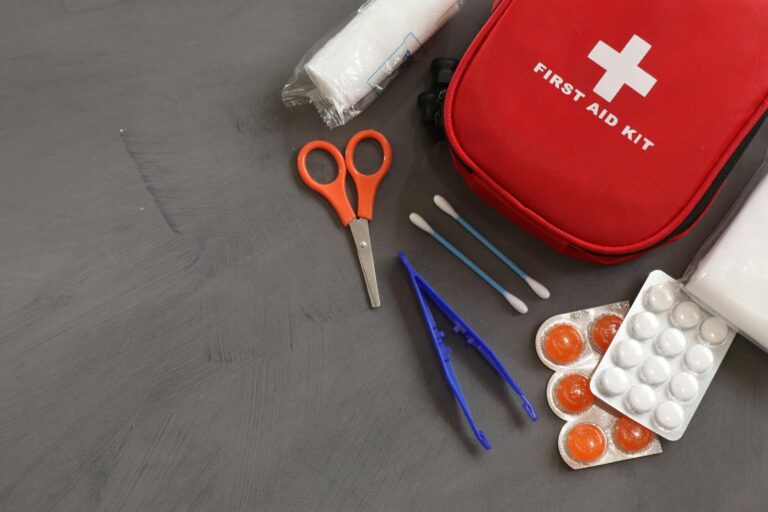
- Adhesive bandages in multiple sizes — children’s-sized (3/4 inch) bandages cover small injuries better than standard adult sizes; also stock cartoon or character designs for younger kids to reduce anxiety
- Sterile gauze pads (2×2 inch and 4×4 inch) — 10 each
- Non-stick wound pads (Telfa) for burns and abrasions — 5 count
- Medical adhesive tape (1-inch and 2-inch rolls)
- Elastic roller bandage (3-inch, for sprains)
- Butterfly closure strips / wound closure strips — for cuts that would otherwise need stitches
- SAM splint (padded, malleable) — can be cut to size for child-sized limbs
- Triangular bandage and safety pins — arm sling and wound dressing
Cleaning and Antiseptics
- Antiseptic wipes (individually wrapped) — 20 count minimum
- Antibiotic ointment (Neosporin or generic) — prevents wound infection in minor cuts and abrasions
- Sterile saline solution (wound wash) — for flushing debris from eyes or wounds; gentler than plain water for kids’ sensitive skin
- Hydrogen peroxide (3%) — use sparingly; more effective for cleaning wound surroundings than the wound itself
- Hand sanitizer (60%+ alcohol) — for caregiver hand hygiene before treating wounds
Assessment and Monitoring Tools
- Digital thermometer (rectal or axillary for infants; oral for older children)
- Pulse oximeter — small, inexpensive ($20–$30) device that measures blood oxygen saturation. Particularly useful for respiratory emergencies and evaluating breathing difficulty in children
- Flashlight with fresh batteries — for examining eyes, ears, and throat in poor light conditions
- Tweezers — fine-point for splinter removal and tick extraction
- Small scissors with rounded tips — safe for trimming bandages and clothing
- Medical gloves (nitrile, size medium/large) — 5 pairs
Children’s Medications: What to Stock and Critical Dosing Notes
This is where children’s first aid kits diverge most significantly from adult kits. Never give adult-formulated medications to children without checking dosing instructions. Never give aspirin to anyone under 18 without physician guidance — it’s associated with Reye’s Syndrome, a rare but serious condition.
Pain and Fever
- Children’s acetaminophen (Tylenol): Available in liquid, chewable, and dissolving strip forms. Stock the liquid for under-6 and the chewable for 6+. Dose by weight, not age — always follow the package dosing chart
- Children’s ibuprofen (Motrin/Advil): Anti-inflammatory and fever reducer. Not for infants under 6 months. Again, dose by weight and follow package instructions
- Write your child’s current weight on the inside cover of your kit and update every 6 months — this makes accurate dosing fast under stress
Allergic Reactions
- Children’s diphenhydramine liquid (Benadryl): For mild allergic reactions, insect bites, and hives. Causes drowsiness — useful information in a stressful situation. Dose by weight for children under 12
- Epinephrine auto-injector (EpiPen Jr.): If any family member has known anaphylaxis risk (severe peanut, bee sting, or other allergy), this is non-negotiable. Requires a prescription. Keep two on hand — one in the home kit, one in the go-bag
Gastrointestinal
- Oral rehydration solution (Pedialyte or equivalent): For vomiting, diarrhea, or heat-related dehydration. Powder packets are more compact for a go-bag than bottled liquid. Children dehydrate far faster than adults — this is a critical supply
- Children’s antacid (liquid form): For stomach upset
Skin
- Calamine lotion — poison ivy, bug bites, and chicken pox rash
- Hydrocortisone cream (1%) — for insect bites, contact dermatitis, and mild allergic skin reactions
- Sunscreen (SPF 30+ broad spectrum) — essential if evacuation or outdoor time is extended
- Insect repellent (DEET or picaridin formulation safe for children over 2 months)
Comfort Supplies for Children in Emergencies
Often overlooked but genuinely important: children in emergencies need comfort alongside medical care. Their emotional state directly affects cooperation with treatment. Consider including:
- Fun bandages (character bandages for kids) — reduces resistance to wound care for young children
- Small lollipop or hard candy — a classic distraction during painful procedures; also useful for children with low blood sugar
- Child-safe comfort items that can be packed with the kit (small stuffed animal, familiar toy)
- Kid-friendly first aid reference card explaining what each item is for, in language children understand
How to Organize and Store Your Children’s First Aid Kit
A disorganized kit in an emergency is almost as bad as no kit. These practices help:
- Use clear zippered pouches organized by category — wound care, medications, tools — inside a main bag or case. Label each pouch
- Keep a laminated reference card with your child’s weight, known allergies, current medications, and pediatrician contact info
- Check medication expiration dates every 6 months — expired medications may be less effective or potentially harmful
- Keep the main home kit in a consistent, accessible location and make sure all adult caregivers and older children know where it’s
- Keep a smaller, travel version in each vehicle and in your go-bag
For a complete family preparedness system, see our family emergency preparedness guide for homesteaders.
Related Reading
Frequently Asked Questions About Children’s First Aid Kits
What’s the most important item in a children’s first aid kit?
Accurate, weight-based dosing information for children’s acetaminophen and ibuprofen is arguably the most critical item — because dosing errors are the most common pediatric medication mistake in emergencies. Write your child’s current weight on a card inside the kit, and update it every 6 months as children grow quickly. A pulse oximeter ($20–$30) is another frequently overlooked item that provides critical information during respiratory emergencies.
Should I use adult medications if I run out of children’s versions?
Don’t substitute adult medications without medical guidance. Adult tablets often can’t be accurately divided to reach pediatric doses, and some adult formulations contain ingredients that are unsafe for children. If pediatric medications are unavailable, contact poison control (1-800-222-1222 in the U.S.) or a medical professional before giving any adult medication to a child.
How is a first aid kit for babies different from one for older children?
Infant kits require: rectal thermometer (most accurate for infants), nasal aspirator (for suctioning congestion), infant-specific nail scissors, and infant-formulation medications dosed in milliliters by weight. Infants can’t have most over-the-counter medications, including ibuprofen under 6 months and most antihistamines. Consult your pediatrician to establish appropriate emergency medication protocols for infants before an emergency.
Do I need a first aid certification to use a children’s first aid kit?
Basic first aid training is strongly recommended and widely available — the American Red Cross offers pediatric first aid and CPR courses online and in person for $30–$60. However, even without formal training, a well-stocked kit with clear labeling and a first aid reference guide enables any caregiver to competently handle minor injuries. For more serious emergencies, the kit keeps you doing something useful while emergency services are en route.
How often should I replace items in my children’s first aid kit?
Check and rotate your kit every 6 months — set a recurring calendar reminder. Medications expire and lose potency. Adhesive bandages lose stickiness. Antiseptic wipes dry out if packaging is compromised. Replace any item that has expired, been used, or shows any sign of damage or contamination. Update your child’s weight on the dosing card at each 6-month check.
Conclusion
A well-stocked children’s first aid kit for emergency preparedness is one of the highest-value investments a family can make. The supplies are inexpensive, the knowledge is learnable, and the confidence it provides is real. Use this checklist to audit what you currently have, fill the gaps, and organize your kit so it’s usable under stress. Then take a pediatric first aid and CPR class — the combination of a complete kit and practical knowledge makes you genuinely capable of protecting your children in a real emergency. For more resources on family preparedness, visit thehomesteadmovement.com/start-here/.
The 72-Hour Checklist Most Families Are Missing
Food, water, power, communications, and family coordination — in a single printable checklist. Free PDF.